I used my new getarg function I wrote to improve the DOS version of chastext. Nothing about the behavior of the program has changed but the code is a lot smaller and more readable. This chastext program was the original reason I wrote the chastearg program. I needed to get the command line arguments just write.
But more importantly, people may not see the value of the chastext program and why it is useful to transform text. For that reason, I took this screenshot of a demo batch file that shows just how much I can modify a text file in stages.
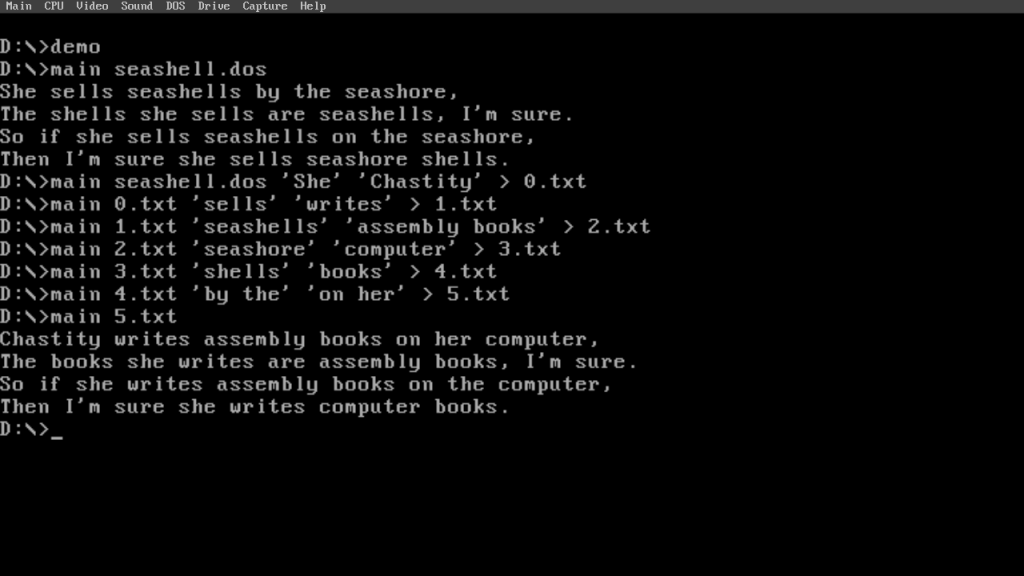
Besides changing a funny tongue twister about seashells into other things (which made a really great example), I also used the Linux version of chastext to make it possible to assemble my DOS programs with either FASM or NASM. The two assemblers are mostly compatible with each other when doing DOS programming due to the lack of headers in ‘.com’ files. Simply replacing “include” with “%include” is enough to transform my FASM source into NASM source because the % is required for the NASM include directive.
FASM is my main assembler but making sure it assembles my code in NASM will also make a difference for those following my book, Assembly Arithmetic Algorithms for DOS. The book is complete and available on leanpub but there are possible corrections to the code if necessary.
And for now, I am also trying to work on the Linux version of the book which will be more work because I have a new angle where I want to compare the Assembly to the C code of the same program. Since Linux developers are more familiar with C, it will help those with C language experience to learn the nature of Assembly language and how it is specifically very useful for Linux systems even more than it is for DOS or Windows.
Also, the source code of the chastext program is available in its own repository.
https://github.com/chastitywhiterose/chastext
C and assembly versions are available which means that it can be either compiled or assembled and run on any operating system that I know about. Almost every platform has a C compiler and my custom assembly programs perform even higher on DOS and Linux than the C version did.
Between chastehex, chastecmp, and now chastext, I have a small set of development tools that I can use for verifying when my programs are producing the output I want. Each tool was made for a specific need I had in mind.


Leave a Reply