Tag: python

  • chastarg for DOS

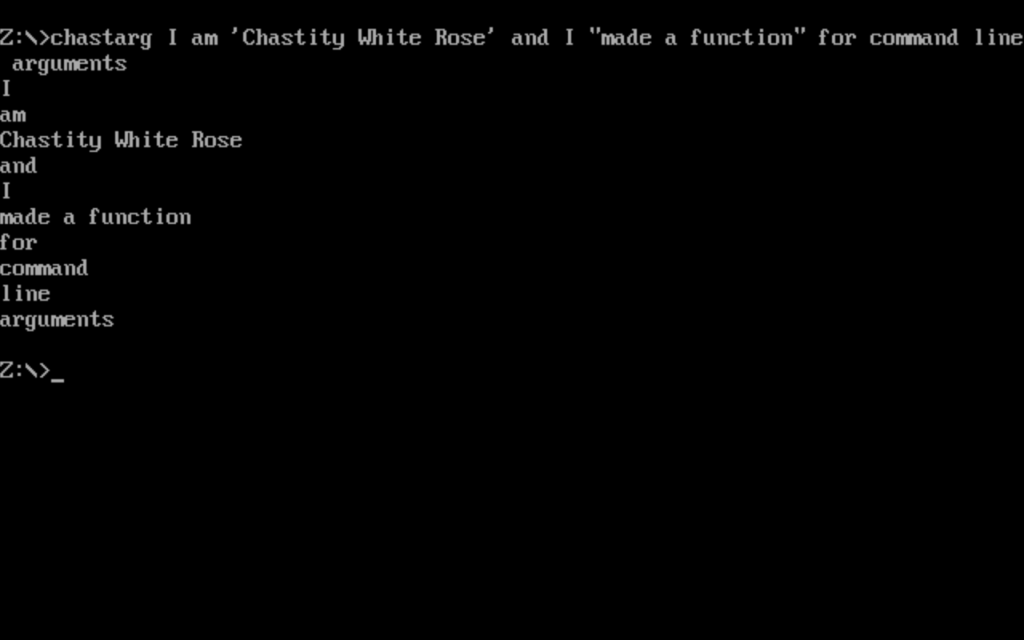
    The chastearg program, which is shortened to chastarg to respect DOS 8.3 filename limits, is a tool for separating command line arguments into multiple lines except preserving those that are quoted and therefore counting as one argument. Quoted strings will print on the same line.

    A key aspect of how this works is the new “getarg” function that I wrote. If you take a look at this small program that uses it, it is very simple.

    main.asm

    org 100h     ;DOS programs start at this address
    
    ;this loop will get all the command line arguments and print them on separate lines
    
    call getarg ;this first call will get the command string
    
    arg_loop:
    call getarg
    cmp ax,0 ;did the getarg function return 0?
    jz arg_loop_end ;if ax was zero, there are no args
    call putstring
    call putline
    jmp arg_loop
    arg_loop_end:
    
    ending:
    mov ax,4C00h ; Exit program
    int 21h
    
    include 'getarg.asm'
    include 'chastelib16.asm'
    
    db 0x48 dup 0 ;add extra bytes to make it 512 bytes exactly
    

    But the getarg function itself is a little bit complicated. I tried my best to comment it so that hopefully other DOS programmers can benefit from this useful function.

    getarg.asm

    ;The getarg function was something I badly needed in order to make my assembly code for DOS easier to read.
    ;It will automatically process the command line arguments if they are available.
    ;
    ;The first time it is run, it returns the whole command string or zero if no args are given
    ;DOS does not allow the program name to be part of the arguments
    ;
    ;Each time after that, it will give you the next argument which is a subtring of the original.
    ;When no more arguments are available, it will always return zero
    ;The program calling this is expected to check for this error and then terminate
    ;or print a message depending on the goals of that program
    
    ;A word of warning though, this function has multiple return statements and is long
    ;However, it is fully featured in that it can recognize quoted strings as being the same argument
    ;This brings full compatibility between my DOS and Linux programs which expect consistent behavior
    
    getarg:
    
    mov bx,[arguments_start] ;get the address of start of arguments
    cmp bx,0 ;is this address zero? (meaning this function was not called before)
    jz get_arg_data ;if it was zero, then get the argument data for the first execution of this function
    
    ;if the start was not zero, then clearly arguments exist and addresses have been saved
    cmp bx,[arguments_end]  ;is the address of the start and end the same?
    jnz find_next_string  ;if they are not the same, find the next sub string
    mov ax,0 ;otherwise, return ax as zero and check this in the main program
    
    ret
    
    find_next_string:
    
    mov bx,[arguments_start] ;get address of current arg
    
    skip_spaces:
    
    cmp byte[bx],' ' ;is this byte a space?
    jnz skip_spaces_end ;if it is not a space, we can end this loop
    inc bx ;otherwise, go to next byte
    jmp skip_spaces ;and keep looping till we find non-space
    skip_spaces_end:
    mov ax,bx ;copy this non-space address to ax register
    
    ;we have found a non-space which is the start of a printable string
    ;but we still have to find the next space and terminate it with a zero!
    
    ;however, there is a special case where we want a string to contain spaces. In this case, I have another routine!
    
    ;check for quoted strings
    cmp byte[bx],0x22 ;is this a double quote -> "
    jz scan_quoted_string
    cmp byte[bx],0x27 ;is this a single quote -> '
    jz scan_quoted_string
    
    find_space:
    cmp byte [bx],' ' ;is this a space?
    jz found_space ;if this was a space, end the loop and terminate with zero
    
    ;we must also check to see if we have reached the terminating zero of the arguments string
    cmp byte[bx],0 ;is this byte a zero?
    jz no_more_args ;if yes this string is already terminated
    
    inc bx
    jmp find_space ; this char was not space, go to the next char
    found_space:
    mov byte[bx],0 ;terminate this string
    
    inc bx ;but go to the next byte
    mov [arguments_start],bx ;and set the new start address for the next call
    
    ret ;We can return ax safely knowing the string ends in a zero
    
    scan_quoted_string:
    
    mov cl,byte[bx] ;mov this quote type to cl
    inc bx ;go to next byte
    mov ax,bx ;set ax to this address which is assumed to be the start of a quoted string
    
    find_end_quote:
    cmp byte[bx],cl ;is this the same quote we started with?
    jz found_end_quote ;if it is, end this loop
    
    ;we must also check to see if we have reached the terminating zero of the arguments string
    ;this avoids a crash if I forgot to add the second quotation mark in the arguments
    cmp byte[bx],0 ;is this byte a zero?
    jz no_more_args ;if yes this string is already terminated
    
    inc bx
    jmp find_end_quote
    found_end_quote:
    mov byte[bx],0 ;terminate this string
    
    inc bx ;but go to the next byte
    mov [arguments_start],bx ;and set the new start address for the next call
    
    ret
    
    no_more_args:
    
    mov [arguments_start],bx ;mov the start to where the string ended
    
    ;now that the start and end addresses are the same
    ;this function will always return zero
    ret
    
    ;this will happen first time this function is called to get the argument data
    get_arg_data:
    mov ax,0      ;zero ax (upper half of ax)
    mov al,[80h] ;load length of the command string from this address
    cmp ax,0
    jz getarg_end
    
    mov bx,0x81  ;mov into bx the address of the start of the argument string
    mov [arguments_start],bx ;save the start of the arguments to this variable
    add bx,ax    ;add the length of the command string to this address
    mov byte[bx],0 ;terminate this with a zero to avoid segfaults when printed with putstring
    mov [arguments_end],bx ;save the end of the arguments to this variable
    mov ax,[arguments_start] ;copy the address of the arguments start to ax
    
    getarg_end:
    ret
    
    ;start and end default to address of zero, which means we have not tested the arguments yet
    arguments_start dw 0
    arguments_end dw 0
    

  • chastext for Windows

    I wrote a Windows Assembly version of my chastext program.

    #main.asm

    format PE console
    include 'win32ax.inc'
    include 'chastelibw32.asm'
    
    main:
    
    mov [radix],10 ; Choose radix for integer output.
    mov [int_width],1
    
    ;get command line argument string
    call [GetCommandLineA]
    
    mov [arg_string_index],eax ;back up eax to restore later
    
    call strlen ;get the length of the string
    
    mov ebx,[arg_string_index] ;mov the address of the string start into ebx
    add ebx,eax                ;add eax which contains the length
    mov [arg_string_end],ebx   ;move end of string address to permanent location
    
    ;optionally display the arg string to make sure it is working correctly
    ;mov eax,[arg_string_index]
    ;call putstring
    ;call putline
    
    ;set ebx back to the start of the arg string for the filter loop
    mov ebx,[arg_string_index]
    
    ;now ebx points to the first non space character in the arguments passed to the DOS program
    ;and we know that [arg_string_end] is where it ends
    
    ;the next step is to filter the arguments into separate zero terminated strings
    ;each space will be changed to a zero (normally)
    ;but we also need to account for spaces inside quotes that are considered part of the string
    ;Linux handles this normally but DOS needs me to write the code to mimic this behavior
    ;because the program needs to function identically for DOS or Linux
    
    mov cl,' ' ;set the default filter character (argument terminator) to a space
    mov ch,0   ;are we currently checking spaces 0 or quote characters 1 as terminators?
    
    ;this loop is the new and improved argument filter
    ;it keeps track of whether we are inside or outside a quote
    ;and also which type of quote started the quote
    ;the actual quote marks are not part of the string unless they
    ;are the opposite quote type than what started the string
    ;The important thing is that spaces can exist inside of quoted strings
    ;as one argument rather than each new word being a new argument
    ;could be important for filenames containing spaces, etc.
    
    argument_filter:
    
    cmp ebx,[arg_string_end] ;are we at the end of the arg string?
    jz argument_filter_end       ;if yes, stop the filter and terminate with zero
    
    cmp ch,1       ;are we inside a quoted string?
    jz quote_check ;if yes, don't do anything to the spaces
    
    cmp byte[ebx],cl ;compare the byte at address bx to the string terminator
    jnz ignore_char ;if it is not the same, we ignore it
    mov byte[ebx],0  ;but if it matches, change it to a zero
    ignore_char:
    
    cmp byte [ebx],0x22 ;is this a double quote -> "
    jz start_quote
    cmp byte [ebx],0x27 ;is this a single quote -> '
    jz start_quote
    jmp quote_no ;it was not a quote
    
    start_quote:
    
    mov ch,1    ;set ch to 1 to set that we are inside a quote now
    mov cl,[ebx] ;save this quote type as the new terminator
    mov byte[ebx],0 ;but delete the first quote with zero
    
    ;check for single or double quotes
    quote_check:
    
    cmp [ebx],cl ;is this character the same type of quote that started this sub string?
    jnz quote_no ;if it is not, then skip to quote_no section
    
    ;but if it was matching, change this byte to zero
    ;and change cl back to a space
    mov cl,' ' ;cl is now a space
    mov ch,0   ;ch is 0 because now we have ended the quoted string
    mov byte[ebx],0 ;delete the end quote with zero
    
    quote_no:
    
    inc ebx ;go to the next character
    jmp argument_filter   ;jump back to the beginning of argument filter
    
    argument_filter_end:
    mov byte [ebx],0 ;terminate the ending with a zero for safety
    
    ;check first argument which is name of program
    ;mov eax,[arg_string_index]
    ;call putstr_and_line
    
    call get_next_arg ;get address of next arg and return into eax register
    cmp eax,[arg_string_end] ;if there is no filename arg, we end
    jnz args_exist
    
    mov eax,help    ;if no arguments were given, show a help message
    call putstring
    jmp ending     ;and end the program because there is nothing to do
    
    args_exist:
    
    mov [filename],eax
    ;call putstr_and_line ;print filename before text output
    
    ;This is where the main part of the chastext program really begins.;
    
    ;now that the argument string is prepared, we will try to use the first argument as a filename to open
    
    ;https://learn.microsoft.com/en-us/windows/win32/api/fileapi/nf-fileapi-createfilea
    ;https://learn.microsoft.com/en-us/windows/win32/secauthz/generic-access-rights
    
    ;open first file with the CreateFileA function
    
    push 0           ;NULL: We are not using a template file
    push 0x80        ;FILE_ATTRIBUTE_NORMAL
    push 3           ;OPEN_EXISTING
    push 0           ;NULL: No security attributes
    push 0           ;NULL: Share mode irrelevant. Only this program reads the file.
    push 0x80000000  ;GENERIC_READ access mode
    push [filename] ;
    call [CreateFileA]
    
    ;check eax for file handle or error code
    ;call putint
    cmp eax,-1
    jnz file_ok
    
    mov eax,file_error_message
    call putstring
    call [GetLastError]
    call putint
    jmp main_end ;end program if the file was not opened
    
    ;this label is jumped to when the file is opened correctly
    file_ok:
    
    mov [filedesc],eax
    
    ;before we proceed, we also check for more arguments.
    
    call get_next_arg ;get address of next arg and return into eax register
    cmp eax,[arg_string_end] ;if at end, no search string argument
    jz textdump ;jump to textdump section
    
    ;otherwise, we save the address at ax to our search string
    mov [string_search],eax
    ;call putstr_and_line
    
    
    call get_next_arg ;get address of next arg and return into ax register
    cmp eax,[arg_string_end] ;if at end, no replacement string argument
    jz textdump ;jump to hexdump section
    
    ;otherwise, we save the address at ax to our replacement string
    mov [string_replace],eax
    ;call putstr_and_line
    
    ;all other arguments that may exist after this are irrelevant
    
    textdump:
    
    ;this is the beginning of the textdump main loop of chastext
    
    ;first, check to see if there is a search string
    ;if there is a search string, skip the normal putchar
    
    cmp dword[string_search],0 ;do we have a search string?
    jnz putchar_skip
    
    ;but if there is not a search string
    ;we will read one character, then display it to stdout
    ;and then jump to the beginning of the textdump loop to print them until EOF
    ;we start the loop with a call to read exactly 1 byte
    
    ;read only 1 byte using Win32 ReadFile system call.
    push 0              ;Optional Overlapped Structure 
    push bytes_read     ;Store Number of Bytes Read from this call
    push 1              ;Number of bytes to read
    push byte_array     ;address to store bytes
    push [filedesc]     ;handle of the open file
    call [ReadFile]
    
    mov eax,[bytes_read]
    
    cmp eax,1        ;check to see if exactly 1 byte was read
    jz file_success ;if true, proceed to display
    ;mov ax,end_of_file
    ;call putstring
    jmp main_end ;otherwise close the file and end program after failure
    
    ; this point is reached if 1 byte was read from the file successfully
    file_success:
    
    mov al,[byte_array]
    call putchar
    jmp textdump
    
    ;if search string doesn't exist, just jump and repeat the loop
    ;otherwise we continue into the next section that compares the input with the search string
    
    putchar_skip:
    
    ;this is the beginning of search mode
    ;it handles the file by seeking and reading to search every position for the search string
    
    ;first, seek to the file_address we initialized to zero
    ;this variable will be added to depending on actions taken
    
    ;seek to address of file with SetFilePointer function
    ;https://learn.microsoft.com/en-us/windows/win32/api/fileapi/nf-fileapi-setfilepointer
    push 0             ;seek from beginning of file (SEEK_SET)
    push 0             ;NULL: We are not using a 64 bit address
    push [file_address] ;where we are seeking to
    push [filedesc] ;seek within this file
    call [SetFilePointer]
    
    ;obtain the length of the search string using my strlen function
    mov eax,[string_search]
    call strlen ;get the length of the search string
    
    mov ecx,eax ;store this length in ecx
    mov [search_length],ecx
    
    ;call putint_and_line ;check length of search string
    
    ;use the length of the string we are searching for as the number of bytes to read at this location
    
    ;Win32 ReadFile system call.
    push 0              ;Optional Overlapped Structure 
    push bytes_read     ;Store Number of Bytes Read from this call
    push ecx            ;Number of bytes to read
    push byte_array     ;address to store bytes
    push [filedesc]     ;handle of the open file
    call [ReadFile]
    
    mov eax,[bytes_read]  ;get how many bytes were read with that last read operation
    
    mov ebx,byte_array    ;move the address of bytes read into bx
    add ebx,eax           ;add number of bytes read (return value of read function in eax)
    mov byte[ebx],0       ;terminate the string with zero
    
    cmp eax,[search_length] ;if the number of bytes is not what we expected to read, end this loop
    jnz textdump_end
    
    ;move our two strings into the esi and edi registers for comparison
    ;with my custom written strcmp function
    
    mov esi,[string_search]
    mov edi,byte_array
    call strcmp ;compare these two strings
    
    cmp eax,0 ;test if they are the same (if eax returned zero)
    jnz not_match ;if they are not a match go to that section for printing a character
    
    ;but if they are a match, then we either quote them
    ;or replace them if a replacement string is available
    
    ;but regardless of which action we do, since a match was found, let us add this count to the file address
    ;so that we read from beyond this point next time the textdump loop starts
    mov eax,[bytes_read]
    add [file_address],eax
    
    cmp dword[string_replace],0 ;check to see if a replacement string is available
    jz print_quotes ;if not, skip to the part where we just quote the strings that match
    
    ;otherwise, we will print the replacement string instead of the original!
    
    mov eax,[string_replace]
    call putstring ;print the string
    
    jmp textdump ;restart the main loop
    
    print_quotes:
    ;print quotes around matched string
    mov al,'"'
    call putchar
    
    mov eax,byte_array
    call putstring ;print the string
    
    mov al,'"'
    call putchar
    
    jmp textdump ;restart the main loop
    
    not_match: 
    
    mov al,[byte_array]
    call putchar
    add [file_address],1 ;add 1 to the file address so we don't read this same position again
    
    jmp textdump
    
    textdump_end:
    
    ;print the remaining bytes, if any, left after the main loop ended
    mov eax,byte_array
    call putstring
    
    main_end:
    
    ;this is the end of the program
    ;we close the open file and then use the exit call
    
    ;close the file
    push [filedesc]
    call [CloseHandle]
    
    
    ending:
    ;Exit the process with code 0
    push 0
    call [ExitProcess]
    
    .end main
    
    arg_string_index  dd 0 ;start of arg string
    arg_string_end    dd 0 ;address of the end of the arg string
    
    ;function to move ahead to the next art
    ;only works after the filter has been applied to turn all spaces into zeroes
    get_next_arg:
    mov ebx,[arg_string_index]
    find_zero:
    cmp byte [ebx],0
    jz found_zero
    inc ebx
    jmp find_zero ; this char is not zero, go to the next char
    found_zero:
    
    find_non_zero:
    cmp ebx,[arg_string_end]
    jz arg_finish ;if ebx is already at end, nothing left to find
    cmp byte [ebx],0
    jnz arg_finish ;if this char is not zero we have found the next string!
    inc ebx
    jmp find_non_zero ;otherwise, keep looking
    
    arg_finish:
    mov [arg_string_index],ebx ; save this index to variable
    mov eax,ebx ;but also save it to ax register for use
    ret
    ;we can know that there are no more arguments when
    ;the either [arg_start] or eax are equal to [arg_end]
    
    ;the strlen and strcmp are named after the equivalent C functions
    ;but are written from scratch by me based on their expected behavior
    
    ;a function to get the length of string in eax and return the integer in eax
    
    strlen:
    
    mov ebx,eax ; copy eax to ebx. ebx will be used as index to the string
    
    strlen_start: ; this loop finds the length of the string as part of the putstring function
    
    cmp [ebx],byte 0 ; compare byte at address ebx with 0
    jz strlen_end ; if comparison was zero, jump to loop end because we have found the length
    inc ebx
    jmp strlen_start
    
    strlen_end:
    sub ebx,eax ;subtract start pointer from current pointer to get length of string
    
    mov eax,ebx ;copy the string length back to eax
    
    ret
    
    ;strcmp compares the string at esi to the one at edi
    ;ax returns 0 if the strings are the same and 1 if different
    ;the algorithm is simple but I will explain it for those who are confused
    
    ;eax is initialized to zero
    ;a byte from each string is loaded into the al and bl registers
    ;the bytes are compared. if they are different, then we jump to the end
    ;However, if they are the same, then we check if one of them is zero
    ;for this purpose it doesn't matter whether we compare al or bl with zero
    ;because it is known that they are the same if the jnz did not take place
    ;if it is zero, this also jumps to the end of the function
    ;If neither jump took place, then we jump to the start of the loop
    ;but when the function finally ends bl will be subtracted from al
    ;this ensures that the function returns zero if the final characters are the same
    
    strcmp:
    
    mov eax,0
    
    strcmp_start:
    
    ;read a byte from each string
    mov al,[edi]
    mov bl,[esi]
    cmp al,bl
    jnz strcmp_end
    
    cmp al,0
    jz strcmp_end
    
    inc edi
    inc esi
    
    jmp strcmp_start
    
    strcmp_end:
    sub al,bl
    
    ret
    
    help db 'chastext by Chastity White Rose',0Dh,0Ah
    db '"cat" or "type" a file without changing it:',0Dh,0Ah,9,'chastext file',0Dh,0Ah
    db 'search for a string and quote it:',0Dh,0Ah,9,'chastext file search',0Dh,0Ah
    db 'replace string:',0Dh,0Ah,9,'chastext file search replace',0Dh,0Ah
    db 'Find or replace any string!',0Dh,0Ah,0
    
    file_error_message db 'Could not open the file! Error number: ',0
    filename dd 0
    filedesc dd 0
    file_address dd 0 ;file address defaults to zero AKA beginning of file
    end_of_file db 'EOF',0
    
    ;where we will store data from the file
    bytes_read dd 0
    
    search_length dd 0
    string_search dd 0 ; place to hold the search string pointer
    string_replace dd 0 ; place to hold the replacement string pointer
    
    byte_array db 0x73 dup 0
    
  • Chastelib Readme and Manifesto

    Chastelib is a library I have been developing since mid 2025, though some of the functions have existed in some form for 20 years and have been hacked together as I needed them for projects. Over the past 6 months, I have refined them and have extensively documented the source code, and have even begun writing a manual on how to use them. This project will take years, as I have fun improving things and explaining why my own methods of outputting numbers now surpass the capabilities of the C and C++ standard libraries when it comes to printing integers in other bases.

    To my knowledge, nobody other than me uses these functions, but they are extremely easy to use by including header files or just copy pasting the functions you like into your own C and C++ projects.

    Core Function List

    • intstr: Convert an integer to astring in bases 2 to 36
    • strint: Convert a string in bases 2 to 36 to an integer
    • putstring: Print a zero-terminated string to standard output
    • putint: Print an integer using intstr and then putstr

    To understand the context of this library and how it came about, you have to know that I have been a C programmer for 25 years. Most of my projects are just toy programs for printing sequences of integers. Even more strange is that I enjoy bases other than ten, referred to as decimal by humans.

    Math is a game to me, and I do computer programming for fun. I also think that the C programming language is the best programming language to ever exist. However, there are some limitations that come with it.

    The printf family of functions can output formatted text containing arbitrary strings of text with format specifiers and arguments to print integers and floating point numbers.

    For integers, there is the %d for decimal, %u for unsigned decimal, %X for hexadecimal, and %o for octal. Although these are the most common number bases used, I prefer the option to print binary. The %b format specifier does exist as a GNU extension, but because I like my code to conform to the 1989 standard, I decided I should write my own set to manage the conversion of integers to and from strings that I can always rely on.

    Of the core functions, only putstring uses a C standard library function. It uses the low-level fwrite function to write a string after finding its length by searching for the terminating zero.

    Although simple, the putstring allows me flexibility when I am translating chastelib to use a new C library, or when I want to translate all the functions to another programming language.

    For example, when using other languages, I can’t rely on printf being available. Moreover, printf is a complicated function to write, and I have no idea how it actually works. When I tried translating my functions to Rust, having putstring as my trusted output function helped a lot. That being said, Rust is a painful language, and I stopped because it hurt my head too much, which is saying something, given how good I am at Assembly language on Intel platforms.

    The putstring function also helped when I was using ncurses because I could just change putstring to call addstr, which does the same thing in the context of terminal programs written with ncurses.

    The other functions don’t read or write to any devices and rely on putstring to show results. However, this means they execute very fast. Not only is C fast because it is a compiled language, but I have incrementally improved my algorithm over months to do the work quickly, and also made the code look good at the same time.

    Of all the functions used, strint is used the least because most of the time I am the only one providing input to my programs. If other people were using my programs, they would of course provide strings from the keyboard that would be parsed as integers. I have tested the function to ensure that it works correctly. In fact, my program chastehex was why the function was originally written. I could have had a generic hexadecimal converting function, but I made one that was flexible and supported any base from 2 to 36.

    Technical note: Base 36 is the highest base because digits 0 to 9 are used for digits less than ten. Letters A through Z are used as 10 to 35, whether they are uppercase or lowercase. The ten digits plus 26 letters of the English Alphabet provide a standard that programmers have used before I was even born. It is a good standard, and so I stuck with it.

    Future Extensions

    • floating point conversions
    • ncurses utilities

    The Github repository with the latest source is here:

    https://github.com/chastitywhiterose/chastelib

  • C chastelib core 2-25-2026

    There comes a time every so often when I find a typo in my source code. I recently found one in the C version of chastelib. I used the opportunity to expand on my existing comments to better explain the purpose of these functions which are used in my chastehex and chastecmp programs.

    I am also working on extension libraries to add to chastelib to support future command line utilities I might write, even if I don’t know what tools I will write. I have dreams of making my own small programming language but what I imagine is more complex that I am prepared for at my skill level and lack of free time.

    I just finished my Programming 2 class about C++ and I have to say that I still prefer C, even though there are some features of C++ such as function overloading that I find extremely cool.

    Anyway, read below this years edition of the 4 functions that make up the core of chastelib, my own standard library I am building.

    /*
     This file is a library of functions written by Chastity White Rose. The functions are for converting strings into integers and integers into strings.
     I did it partly for future programming plans and also because it helped me learn a lot in the process about how pointers work
     as well as which features the standard library provides, and which things I need to write my own functions for.
    
     As it turns out, the integer output routines for C are too limited for my tastes. This library corrects this problem.
     Using the global variables and functions in this file, integers can be output in bases/radixes 2 to 36
    */
    
    /*
     These two lines define a static array with a size big enough to store the digits of an integer, including padding it with extra zeroes.
     The integer conversion function always references a pointer to this global string, and this allows other standard library functions
     such as printf to display the integers to standard output or even possibly to files.
    */
    
    #define usl 32 /*usl stands for Unsigned String Length*/
    char int_string[usl+1]; /*global string which will be used to store string of integers. Size is usl+1 for terminating zero*/
    
     /*radix or base for integer output. 2=binary, 8=octal, 10=decimal, 16=hexadecimal*/
    int radix=2;
    /*default minimum digits for printing integers*/
    int int_width=1;
    
    /*
    This function is one that I wrote because the standard library can display integers as decimal, octal, or hexadecimal, but not any other bases(including binary, which is my favorite).
    My function corrects this, and in my opinion, such a function should have been part of the standard library, but I'm not complaining because now I have my own, which I can use forever!
    More importantly, it can be adapted for any programming language in the world if I learn the basics of that language.
    */
    
    char *intstr(unsigned int i)
    {
     int width=0;
     char *s=int_string+usl;
     *s=0;
     while(i!=0 || width<int_width)
     {
      s--;
      *s=i%radix;
      i/=radix;
      if(*s<10){*s+='0';}
      else{*s=*s+'A'-10;}
      width++;
     }
     return s;
    }
    
    /*
     This function prints a string using fwrite.
     This algorithm is the best C representation of how my Assembly programs also work.
     Its true purpose is to be used in the putint function for conveniently printing integers, 
     but it can print any valid string.
    */
    
    void putstring(const char *s)
    {
     int c=0;
     const char *p=s;
     while(*p++){c++;} 
     fwrite(s,1,c,stdout);
    }
    
    /*
     This function uses both intstr and putstring to print an integer in the currently selected radix and width.
    */
    
    void putint(unsigned int i)
    {
     putstring(intstr(i));
    }
    
    /*
     This function is my own replacement for the strtol function from the C standard library.
     I didn't technically need to make this function because the functions from stdlib.h can already convert strings from bases 2 to 36 into integers.
     However, my function is simpler because it only requires 2 arguments instead of three, and it also does not handle negative numbers.
    I have never needed negative integers, but if I ever do, I can use the standard functions or write my own in the future.
    */
    
    int strint(const char *s)
    {
     int i=0;
     char c;
     if( radix<2 || radix>36 ){printf("Error: radix %i is out of range!\n",radix);}
     while( *s == ' ' || *s == '\n' || *s == '\t' ){s++;} /*skip whitespace at beginning*/
     while(*s!=0)
     {
      c=*s;
      if( c >= '0' && c <= '9' ){c-='0';}
      else if( c >= 'A' && c <= 'Z' ){c-='A';c+=10;}
      else if( c >= 'a' && c <= 'z' ){c-='a';c+=10;}
      else if( c == ' ' || c == '\n' || c == '\t' ){break;}
      else{printf("Error: %c is not an alphanumeric character!\n",c);break;}
      if(c>=radix){printf("Error: %c is not a valid character for radix %i\n",*s,radix);break;}
      i*=radix;
      i+=c;
      s++;
     }
     return i;
    }
    
    /*
     Those four functions above are the core of chastelib.
     While there may be extensions written for specific programs, these functions are essential for absolutely every program I write.
     
     The only reason you would not need them is if you only output numbers in decimal or hexadecimal, because printf in C can do all that just fine.
     However, the reason my core functions are superior to printf is that printf and its family of functions require the user to memorize all the arcane symbols for format specifiers.
     
     The core functions are primarily concerned with standard output and the conversion of strings and integers. They do not deal with input from the keyboard or files. A separate extension will be written for my programs that need these features.
    */
    
  • New C test program for chastelib

    In my last post, I showed the test program for the Rust version of chastelib. I decided it would make sense to design a similar test program that uses the original C version of the library that I used when converting to Rust. Personally I like this version better. Global variables makes the code cleaner in my opinion because otherwise how would I choose which order the arguments to the functions would go in? This way, the radix and width of the integer string are set by global data before calling the putint function.

    Also notice that the b variable is set to an integer by a string using strint. This is only to demonstrate proper use of the function. Normally it would not be used unless getting string input from a user by command line argument such as was done in chastehex.

    In any case, this library controls all the integer and string conversion so that I can use it in larger projects. Because it is in ANSI C, it is portable to any machine that exists in modern times.

    main.c

    #include <stdio.h>
    #include <stdlib.h>
    #include "chastelib.h"
    
    int main(int argc, char *argv[])
    {
     int a=0,b;
    
     radix=16;
     int_width=1;
    
     putstring("This is the official test program for the C version of chastelib.\n");
     b=strint("100");
    
     putstring("Hello World!\n");
     
     while(a<b)
     {
      radix=2;
      int_width=8;
      putint(a);
      putstring(" ");
      radix=16;
      int_width=2;
      putint(a);
      putstring(" ");
      radix=10;
      int_width=3;
      putint(a);
    
      if(a>=0x20 && a<=0x7E)
      {
       putstring(" ");
       putchar(a);
      }
    
      putstring("\n");
      a+=1;
     }
      
     return 0;
    }
    

    Below is the command to compile and run it and the output.

    gcc -Wall -ansi -pedantic main.c -o main && ./main
    This is the official test program for the C version of chastelib.
    Hello World!
    00000000 00 000
    00000001 01 001
    00000010 02 002
    00000011 03 003
    00000100 04 004
    00000101 05 005
    00000110 06 006
    00000111 07 007
    00001000 08 008
    00001001 09 009
    00001010 0A 010
    00001011 0B 011
    00001100 0C 012
    00001101 0D 013
    00001110 0E 014
    00001111 0F 015
    00010000 10 016
    00010001 11 017
    00010010 12 018
    00010011 13 019
    00010100 14 020
    00010101 15 021
    00010110 16 022
    00010111 17 023
    00011000 18 024
    00011001 19 025
    00011010 1A 026
    00011011 1B 027
    00011100 1C 028
    00011101 1D 029
    00011110 1E 030
    00011111 1F 031
    00100000 20 032  
    00100001 21 033 !
    00100010 22 034 "
    00100011 23 035 #
    00100100 24 036 $
    00100101 25 037 %
    00100110 26 038 &
    00100111 27 039 '
    00101000 28 040 (
    00101001 29 041 )
    00101010 2A 042 *
    00101011 2B 043 +
    00101100 2C 044 ,
    00101101 2D 045 -
    00101110 2E 046 .
    00101111 2F 047 /
    00110000 30 048 0
    00110001 31 049 1
    00110010 32 050 2
    00110011 33 051 3
    00110100 34 052 4
    00110101 35 053 5
    00110110 36 054 6
    00110111 37 055 7
    00111000 38 056 8
    00111001 39 057 9
    00111010 3A 058 :
    00111011 3B 059 ;
    00111100 3C 060 <
    00111101 3D 061 =
    00111110 3E 062 >
    00111111 3F 063 ?
    01000000 40 064 @
    01000001 41 065 A
    01000010 42 066 B
    01000011 43 067 C
    01000100 44 068 D
    01000101 45 069 E
    01000110 46 070 F
    01000111 47 071 G
    01001000 48 072 H
    01001001 49 073 I
    01001010 4A 074 J
    01001011 4B 075 K
    01001100 4C 076 L
    01001101 4D 077 M
    01001110 4E 078 N
    01001111 4F 079 O
    01010000 50 080 P
    01010001 51 081 Q
    01010010 52 082 R
    01010011 53 083 S
    01010100 54 084 T
    01010101 55 085 U
    01010110 56 086 V
    01010111 57 087 W
    01011000 58 088 X
    01011001 59 089 Y
    01011010 5A 090 Z
    01011011 5B 091 [
    01011100 5C 092 \
    01011101 5D 093 ]
    01011110 5E 094 ^
    01011111 5F 095 _
    01100000 60 096 `
    01100001 61 097 a
    01100010 62 098 b
    01100011 63 099 c
    01100100 64 100 d
    01100101 65 101 e
    01100110 66 102 f
    01100111 67 103 g
    01101000 68 104 h
    01101001 69 105 i
    01101010 6A 106 j
    01101011 6B 107 k
    01101100 6C 108 l
    01101101 6D 109 m
    01101110 6E 110 n
    01101111 6F 111 o
    01110000 70 112 p
    01110001 71 113 q
    01110010 72 114 r
    01110011 73 115 s
    01110100 74 116 t
    01110101 75 117 u
    01110110 76 118 v
    01110111 77 119 w
    01111000 78 120 x
    01111001 79 121 y
    01111010 7A 122 z
    01111011 7B 123 {
    01111100 7C 124 |
    01111101 7D 125 }
    01111110 7E 126 ~
    01111111 7F 127
    10000000 80 128
    10000001 81 129
    10000010 82 130
    10000011 83 131
    10000100 84 132
    10000101 85 133
    10000110 86 134
    10000111 87 135
    10001000 88 136
    10001001 89 137
    10001010 8A 138
    10001011 8B 139
    10001100 8C 140
    10001101 8D 141
    10001110 8E 142
    10001111 8F 143
    10010000 90 144
    10010001 91 145
    10010010 92 146
    10010011 93 147
    10010100 94 148
    10010101 95 149
    10010110 96 150
    10010111 97 151
    10011000 98 152
    10011001 99 153
    10011010 9A 154
    10011011 9B 155
    10011100 9C 156
    10011101 9D 157
    10011110 9E 158
    10011111 9F 159
    10100000 A0 160
    10100001 A1 161
    10100010 A2 162
    10100011 A3 163
    10100100 A4 164
    10100101 A5 165
    10100110 A6 166
    10100111 A7 167
    10101000 A8 168
    10101001 A9 169
    10101010 AA 170
    10101011 AB 171
    10101100 AC 172
    10101101 AD 173
    10101110 AE 174
    10101111 AF 175
    10110000 B0 176
    10110001 B1 177
    10110010 B2 178
    10110011 B3 179
    10110100 B4 180
    10110101 B5 181
    10110110 B6 182
    10110111 B7 183
    10111000 B8 184
    10111001 B9 185
    10111010 BA 186
    10111011 BB 187
    10111100 BC 188
    10111101 BD 189
    10111110 BE 190
    10111111 BF 191
    11000000 C0 192
    11000001 C1 193
    11000010 C2 194
    11000011 C3 195
    11000100 C4 196
    11000101 C5 197
    11000110 C6 198
    11000111 C7 199
    11001000 C8 200
    11001001 C9 201
    11001010 CA 202
    11001011 CB 203
    11001100 CC 204
    11001101 CD 205
    11001110 CE 206
    11001111 CF 207
    11010000 D0 208
    11010001 D1 209
    11010010 D2 210
    11010011 D3 211
    11010100 D4 212
    11010101 D5 213
    11010110 D6 214
    11010111 D7 215
    11011000 D8 216
    11011001 D9 217
    11011010 DA 218
    11011011 DB 219
    11011100 DC 220
    11011101 DD 221
    11011110 DE 222
    11011111 DF 223
    11100000 E0 224
    11100001 E1 225
    11100010 E2 226
    11100011 E3 227
    11100100 E4 228
    11100101 E5 229
    11100110 E6 230
    11100111 E7 231
    11101000 E8 232
    11101001 E9 233
    11101010 EA 234
    11101011 EB 235
    11101100 EC 236
    11101101 ED 237
    11101110 EE 238
    11101111 EF 239
    11110000 F0 240
    11110001 F1 241
    11110010 F2 242
    11110011 F3 243
    11110100 F4 244
    11110101 F5 245
    11110110 F6 246
    11110111 F7 247
    11111000 F8 248
    11111001 F9 249
    11111010 FA 250
    11111011 FB 251
    11111100 FC 252
    11111101 FD 253
    11111110 FE 254
    11111111 FF 255


    Finally, here is the source to the library itself which was included by main.c at the top of the post.

    chastelib.h

    /*
    This file is a library of functions written by Chastity White Rose. The functions are for converting strings into integers and integers into strings. I did it partly for future programming plans and also because it helped me learn a lot in the process about how pointers work as well as which features the standard library provides and which things I need to write my own functions for.
    */
    
    /* These two lines define a static array with a size big enough to store the digits of an integer including padding it with extra zeroes. The function which follows always returns a pointer to this global string and this allows other standard library functions such as printf to display the integers to standard output or even possibly to files.*/
    
    #define usl 32
    char int_string[usl+1]; /*global string which will be used to store string of integers*/
    
     /*radix or base for integer output. 2=binary, 8=octal, 10=decimal, 16=hexadecimal*/
    int radix=2;
    /*default minimum digits for printing integers*/
    int int_width=1;
    
    /*
    This function is one that I wrote because the standard library can display integers as decimai, octai, or hexadecimal but not any other bases(including binary which is my favorite). My function corrects this and in my opinion such a function should have been part of the standard library but I'm not complaining because now I have my own which I can use forever!
    */
    
    char* intstr(unsigned int i)
    {
     int width=0;
     char *s=int_string+usl;
     *s=0;
     while(i!=0 || width<int_width)
     {
      s--;
      *s=i%radix;
      i/=radix;
      if(*s<10){*s+='0';}else{*s=*s+'A'-10;}
      width++;
     }
    
     return s;
    }
    
    /*
    This function is my own replacement for the strtol function from the C standard library. I didn't technically need to make this function because the functions from stdlib.h can already convert strings from bases 2 to 36 into integers. However my function is simpler because it only requires 2 arguments instead of three and it also does not handle negative numbers. Never have I needed negative integers but if I ever do I can use the standard functions or write my own in the future.
    */
    
    int strint(char *s)
    {
     int i=0;
     char c;
     if( radix<2 || radix>36 ){printf("Error: radix %i is out of range!\n",radix);return i;}
     while( *s == ' ' || *s == '\n' || *s == '\t' ){s++;} /*skip whitespace at beginning*/
     while(*s!=0)
     {
      c=*s;
      if( c >= '0' && c <= '9' ){c-='0';}
      else if( c >= 'A' && c <= 'Z' ){c-='A';c+=10;}
      else if( c >= 'a' && c <= 'z' ){c-='a';c+=10;}
      else if( c == ' ' || c == '\n' || c == '\t' ){return i;}
      else{printf("Error: %c is not an alphanumeric character!\n",c);return i;}
      if(c>=radix){printf("Error: %c is not a valid character for radix %i\n",*s,radix);return i;}
      i*=radix;
      i+=c;
      s++;
     }
     return i;
    }
    
    /*
    this function prints a string using fwrite
    This is the best C representation of how my Assembly programs also work/
    */
    
    void putstring(char *s)
    {
     int c=0;
     char *p=s;
     while(*p++){c++;} 
     fwrite(s,1,c,stdout);
    }
    
    void putint(unsigned int i)
    {
     putstring(intstr(i));
    }