This is a screenshot of a test program in two different versions. Meld allows me to see them side by side.

When I assembly and run these programs, I get the result
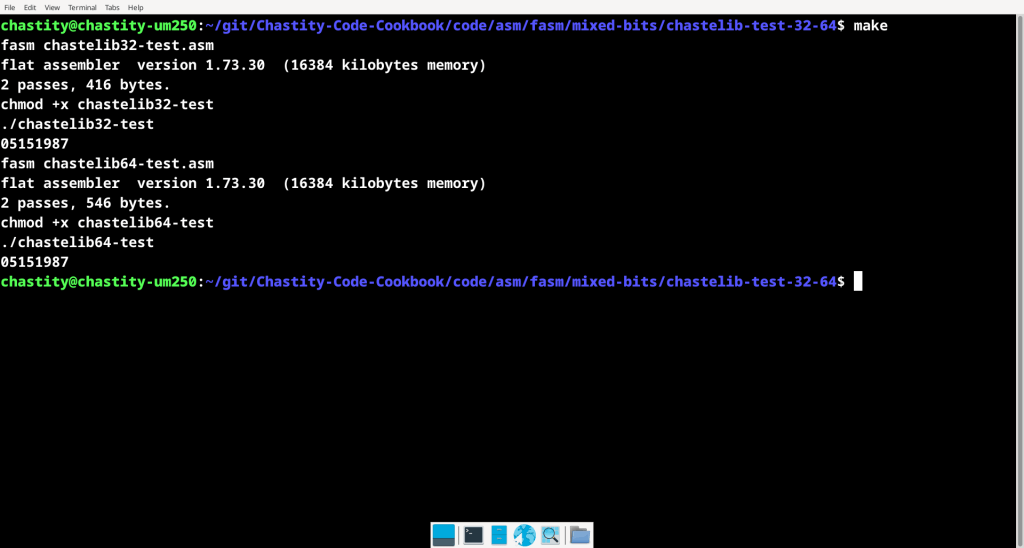
Basically, my program has a binary input string which is the same as the decimal number that looks like my birthday. This program was a basic test of “chastelib”, my Assembly Language library of functions for input and output. Writing these IO routines is one of the hardest parts for most assembly language programmers.
Included in this post is the full source of both the 32 and 64 bit editions of my library.
First, here is the 32 bit version.
; This file is where I keep my function definitions.
; These are usually my string and integer output routines.

; function to print zero terminated string pointed to by register eax

putstring:

mov edx,eax ; copy eax to edx as well. Now both registers have the address of the main_string

putstring_strlen_start: ; this loop finds the lenge of the string as part of the putstring function

cmp [edx],byte 0 ; compare byte at address edx with 0
jz strlen_end ; if comparison was zero, jump to loop end because we have found the length
inc edx
jmp putstring_strlen_start

strlen_end:
sub edx,eax ; edx will now have correct number of bytes when we use it for the system write call

mov ecx,eax ; pointer/address of string to write
mov eax, 4  ; invoke SYS_WRITE (kernel opcode 4 on 32 bit systems)
;mov ebx, 1 ; write to the STDOUT file
int 80h     ; system call to write the message

ret ; this is the end of the putstring function return to calling location

;this is the location in memory where digits are written to by the putint function
int_string     db 32 dup '?' ;enough bytes to hold maximum size 32-bit binary integer
; this is the end of the integer string optional line feed and terminating zero
; clever use of this label can change the ending to be a different character when needed
int_string_end db 0Ah,0

radix dd 2 ;radix or base for integer output. 2=binary, 8=octal, 10=decimal, 16=hexadecimal
int_width dd 8

;this function creates a string of the integer in eax
;it uses the above radix variable to determine base from 2 to 36
;it then loads eax with the address of the string
;this means that it can be used with the putstring function

intstr:

mov ebp,int_string_end-1 ;find address of lowest digit(just before the newline 0Ah)
mov ecx,1

digits_start:

mov edx,0;
mov esi,[radix] ;radix is from memory location just before this function
div esi
cmp edx,10
jb decimal_digit
jge hexadecimal_digit

decimal_digit: ;we go here if it is only a digit 0 to 9
add edx,'0'
jmp save_digit

hexadecimal_digit:
sub edx,10
add edx,'A'

save_digit:

mov [ebp],dl
cmp eax,0
jz intstr_end
dec ebp
inc ecx
jmp digits_start

intstr_end:

prefix_zeros:
cmp ecx,[int_width]
jnb end_zeros
dec ebp
mov [ebp],byte '0'
inc ecx
jmp prefix_zeros
end_zeros:

mov eax,ebp ; now that the digits have been written to the string, display it!

ret


; function to print string form of whatever integer is in eax
; The radix determines which number base the string form takes.
; Anything from 2 to 36 is a valid radix
; in practice though, only bases 2,8,10,and 16 will make sense to other programmers
; this function does not process anything by itself but calls the combination of my other
; functions in the order I intended them to be used.

putint:

push eax ;save eax on the stack to restore later

call intstr

call putstring

pop eax  ;load eax from the stack so it will be as it was before this function was called

ret

;this function converts a string pointed to by eax into an integer returned in eax instead
;it is a little complicated because it has to account for whether the character in
;a string is a decimal digit 0 to 9, or an alphabet character for bases higher than ten
;it also checks for both uppercase and lowercase letters for bases 11 to 36
;finally, it checks if that letter makes sense for the base.
;For example, G to Z cannot be used in hexadecimal, only A to F can
;The purpose of writing this function was to be able to accept user input as integers

strint:

mov esi,eax ;copy string address from eax to esi because eax will be replaced soon!
mov eax,0

read_strint:
mov ecx,0 ; zero ecx so only lower 8 bits are used
mov cl,[esi]
inc esi
cmp cl,0 ; compare byte at address edx with 0
jz strint_end ; if comparison was zero, this is the end of string

;if char is below '0' or above '9', it is outside the range of these and is not a digit
cmp cl,'0'
jb not_digit
cmp cl,'9'
ja not_digit

;but if it is a digit, then correct and process the character
is_digit:
sub cl,'0'
jmp process_char

not_digit:
;it isn't a digit, but it could be perhaps and alphabet character
;which is a digit in a higher base

;if char is below 'A' or above 'Z', it is outside the range of these and is not capital letter
cmp cl,'A'
jb not_upper
cmp cl,'Z'
ja not_upper

is_upper:
sub cl,'A'
add cl,10
jmp process_char

not_upper:

;if char is below 'a' or above 'z', it is outside the range of these and is not lowercase letter
cmp cl,'a'
jb not_lower
cmp cl,'z'
ja not_lower

is_lower:
sub cl,'a'
add cl,10
jmp process_char

not_lower:

;if we have reached this point, result invalid and end function
jmp strint_end

process_char:

cmp ecx,[radix] ;compare char with radix
jae strint_end ;if this value is above or equal to radix, it is too high despite being a valid digit/alpha

mov edx,0 ;zero edx because it is used in mul sometimes
mul [radix]    ;mul eax with radix
add eax,ecx

jmp read_strint ;jump back and continue the loop if nothing has exited it

strint_end:

ret
Here is the 64 bit version.
; This file is where I keep my function definitions.
; These are usually my string and integer output routines.

; function to print zero terminated string pointed to by register rax

putstring:

mov rdx,rax ; copy rax to rdx as well. Now both registers have the address of the main_string

putstring_strlen_start: ; this loop finds the lenge of the string as part of the putstring function

cmp [rdx],byte 0 ; compare byte at address rdx with 0
jz strlen_end ; if comparison was zero, jump to loop end because we have found the length
inc rdx
jmp putstring_strlen_start

strlen_end:
sub rdx,rax ; rdx will now have correct number of bytes when we use it for the system write call

mov rsi,rax ; pointer/address of string to write
mov rax,1   ; invoke SYS_WRITE (kernel opcode 1 on 64 bit systems)
;mov rdi,1  ; write to the STDOUT file
syscall     ; system call to write the message

ret ; this is the end of the putstring function return to calling location

;this is the location in memory where digits are written to by the putint function
int_string     db 64 dup '?' ;enough bytes to hold maximum size 64-bit binary integer
; this is the end of the integer string optional line feed and terminating zero
; clever use of this label can change the ending to be a different character when needed
int_string_end db 0Ah,0

radix dq 2 ;radix or base for integer output. 2=binary, 8=octal, 10=decimal, 16=hexadecimal
int_width dq 8

;this function creates a string of the integer in rax
;it uses the above radix variable to determine base from 2 to 36
;it then loads rax with the address of the string
;this means that it can be used with the putstring function

intstr:

mov rbp,int_string_end-1 ;find address of lowest digit(just before the newline 0Ah)
mov rcx,1

digits_start:

mov rdx,0;
mov rsi,[radix] ;radix is from memory location just before this function
div rsi
cmp rdx,10
jb decimal_digit
jge hexadecimal_digit

decimal_digit: ;we go here if it is only a digit 0 to 9
add rdx,'0'
jmp save_digit

hexadecimal_digit:
sub rdx,10
add rdx,'A'

save_digit:

mov [ebp],dl
cmp rax,0
jz intstr_end
dec rbp
inc rcx
jmp digits_start

intstr_end:

prefix_zeros:
cmp rcx,[int_width]
jnb end_zeros
dec rbp
mov [rbp],byte '0'
inc rcx
jmp prefix_zeros
end_zeros:

mov rax,rbp ; now that the digits have been written to the string, display it!

ret


; function to print string form of whatever integer is in rax
; The radix determines which number base the string form takes.
; Anything from 2 to 36 is a valid radix
; in practice though, only bases 2,8,10,and 16 will make sense to other programmers
; this function does not process anything by itself but calls the combination of my other
; functions in the order I intended them to be used.

putint:

push rax ;save rax on the stack to restore later

call intstr

call putstring

pop rax  ;load rax from the stack so it will be as it was before this function was called

ret

;this function converts a string pointed to by eax into an integer returned in eax instead
;it is a little complicated because it has to account for whether the character in
;a string is a decimal digit 0 to 9, or an alphabet character for bases higher than ten
;it also checks for both uppercase and lowercase letters for bases 11 to 36
;finally, it checks if that letter makes sense for the base.
;For example, G to Z cannot be used in hexadecimal, only A to F can
;The purpose of writing this function was to be able to accept user input as integers

strint:

mov rsi,rax ;copy string address from eax to esi because eax will be replaced soon!
mov rax,0

read_strint:
mov rcx,0 ; zero ecx so only lower 8 bits are used
mov cl,[rsi]
inc rsi
cmp cl,0 ; compare byte at address edx with 0
jz strint_end ; if comparison was zero, this is the end of string

;if char is below '0' or above '9', it is outside the range of these and is not a digit
cmp cl,'0'
jb not_digit
cmp cl,'9'
ja not_digit

;but if it is a digit, then correct and process the character
is_digit:
sub cl,'0'
jmp process_char

not_digit:
;it isn't a digit, but it could be perhaps and alphabet character
;which is a digit in a higher base

;if char is below 'A' or above 'Z', it is outside the range of these and is not capital letter
cmp cl,'A'
jb not_upper
cmp cl,'Z'
ja not_upper

is_upper:
sub cl,'A'
add cl,10
jmp process_char

not_upper:

;if char is below 'a' or above 'z', it is outside the range of these and is not lowercase letter
cmp cl,'a'
jb not_lower
cmp cl,'z'
ja not_lower

is_lower:
sub cl,'a'
add cl,10
jmp process_char

not_lower:

;if we have reached this point, result invalid and end function
jmp strint_end

process_char:

cmp rcx,[radix] ;compare char with radix
jae strint_end ;if this value is above or equal to radix, it is too high despite being a valid digit/alpha

mov rdx,0 ;zero edx because it is used in mul sometimes
mul [radix]    ;mul eax with radix
add rax,rcx

jmp read_strint ;jump back and continue the loop if nothing has exited it

strint_end:

ret
The purpose of this post is mostly as a backup, in addition to my git repository that I use for my programming book. These functions represent my years of experience at converting between number bases.
 Chastity White Rose